In Zurich, DYKWON worked in a room with blue cloth on the walls and floor, ringed by eighteen cameras that rebuilt a person in 3D. He gave people the same instruction — raise your arm — and got curves that would not match. One wrist rose first; another led with the shoulder. He spent days cleaning what he took for noise, and the curves stayed different. What he had treated as error was the difference between people.
The people who made the curves did not know how their arms moved until they saw the lines. An injured shoulder takes a different path for years afterward. People know more with their bodies than they can say.
To measure that difference he needed a motion that repeats. In spring 2005 he put an acceleration sensor on a wrist and went to a taekwondo gym; he had trained in taekwondo since childhood. One instructor and six beginners threw the same punch. To the eye it was one motion; the sensor gave seven records. In them he found joints: a motion starts from a stop, passes through a flow, and ends at a stop. He called each piece a Motion Chunk, so that a teacher can point to the exact place where two students part.
His doctorate, at the Computer Graphics Laboratory of ETH Zurich under Markus Gross, turned this around. Devices of the time understood a short, fixed list of gestures. In his framework the user registers a movement and what it should do, and the machine learns it. He counts the choreographer Merce Cunningham among his influences — a dancer who let chance and, later, computers take part in composing movement. DYKWON’s version gave the composing back to the person.
One figure in the thesis draws the whole path. A gesture starts as an idea in the mind, takes shape in the body, and reaches the machine as a signal. Along the way two errors enter: the performance error of the user, whose body never quite does what was meant, and the measurement error of the system. The model was built to remove both.
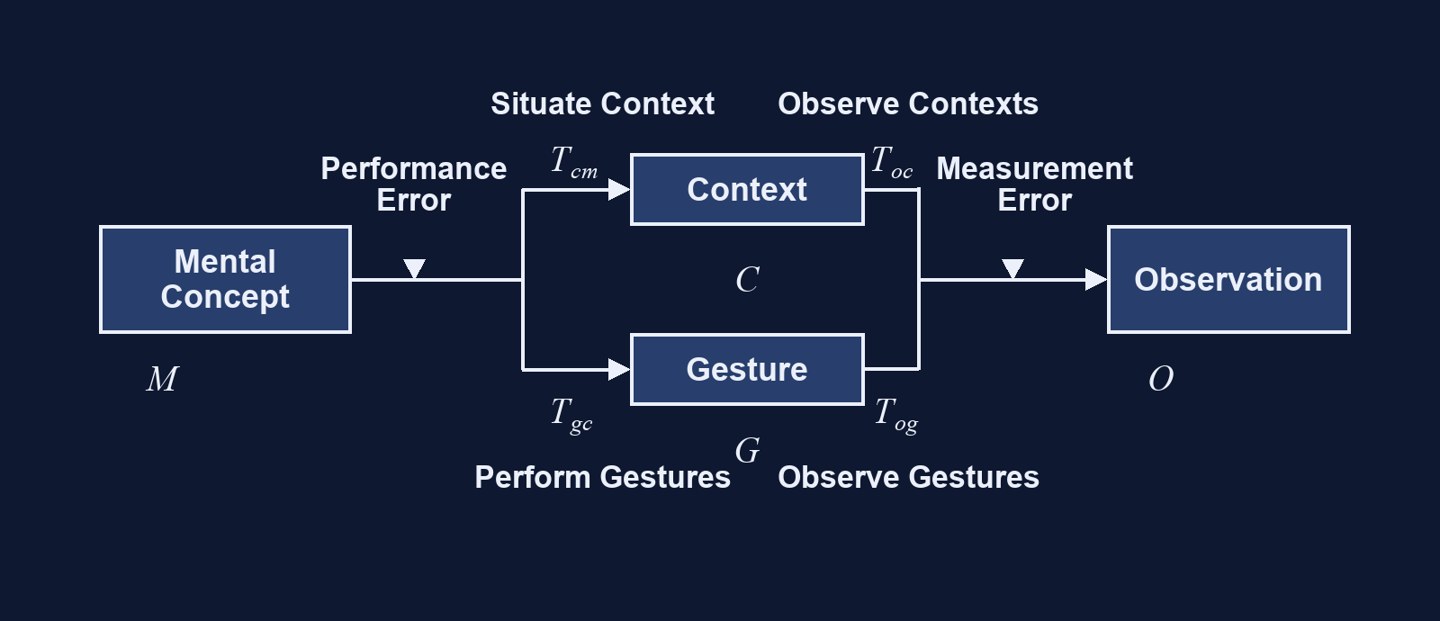
Yet the first error is the one the gym had already shown. A beginner learns how each stance is held, then links one stance to the next, and in endless repetition finds a way of moving that fits that one body: a personal rule. Then the rule is broken, and the breaking is how the practice grows. What a machine counts as performance error is, seen from the floor of the gym, the effort to break a rule. Turning that error into a new rule is the process DYKWON has kept returning to.
In Go to Next the same loop became a way of painting: the computer scattered random dots, a chosen pattern set the grain of the next round, and the final choice was painted by hand in acrylic.
The next tool in this line is still being made: a Gesture Agent, in which one movement of the hand, read by a camera, directs an AI agent at work.